
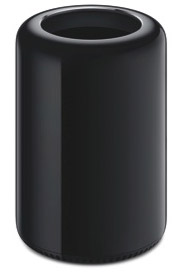
 First, let’s be clear: The new MacPro is not yet shipping. So, like a group of blind folks describing an elephant, we are getting a lot of different opinions on what this new animal is.
Second, the instant Apple revealed it at the WWDC last spring, I wanted one.
Third, buying new hardware is stressful and expensive; especially when it comes to hardware essential to our business.
So, the question I want to answer today is: Since I need to save my pennies to buy this, where do I get the best bang for the buck? And my answers are the same if I were working with Final Cut Pro X, Adobe Premiere CC, or audio editing in ProTools or Audition.
If money means nothing to you, then buy the system with all the bells and whistles. Then, sit back and smirk while the rest of us hate you. For most of us, buying hardware is a trade-off between what we want and what we can afford. In other words, if finding the balance between the best performance at the best price is important to you, this article is for you.
BACKGROUND
Last week, Apple posted more details about the MacPro (including performance and tech specs): http://www.apple.com/mac-pro/
They also announced two configurations: a four-core CPU system starting at $2,999 and a six-core CPU system starting at $3,999. Within those two categories, Apple has not yet announced any other options or pricing. The MacPro is scheduled to ship in December. No date was announced.
Based on what we know, there are five areas we can spend money on with this unit:
So, given these choices, where should we spend our money?
WHERE’S THE BEST BANG FOR THE BUCK?
 Surprisingly, it isn’t the CPU. Any CPU today can easily edit video – even high-resolution video. If you are editing single stream video, even high-resolution, the four-core system will be more than adequate. More cores will be helpful with multicam editing.
Because rendering and exporting is off-loaded to the GPU, a screamingly-fast CPU is not as important as it was in years past. Again, more cores and faster CPU speed is nice, but no longer essential. There are better places to put your money.
Specifically, the best place to spend your money is on the GPU. Get the fastest one you can afford, with as much VRAM as possible. Whether you are editing with Premiere Pro CC or Final Cut Pro X, both max out GPU performance.
RAM is user-upgradeable. This means that you can buy less than you might ultimately need, then upgrade as RAM prices come down and third-party vendors provide reliable upgrades. For me, I’d start with a minimum of 8 GB, then add RAM via third-parties.
NOTE: I don’t expect a lot of RAM options to be available at launch. It will probably take suppliers like Kingston – www.kingston.com – or Crucial – www.crucial.com – a while to ramp up to meet demand.
SECOND NOTE: I spoke with the folks at Kingston earlier today, who told me that, according to the specs of the MacPro: “It can take [RAM] up to 1866MHz in speed, and up to 16GB modules in each of the four slots. We will have memory for this. [Since] the product will be released in December we don’t have an ETA on our memory yet.”
STORAGE
The Mac Pro supports up to 1 TB of SSD (Solid State Drive) storage. First, you don’t need that much, and second, I’m not convinced SSDs are the way to go for media. Instead, an SSD drive is ideally suited for the boot drive. I have an SSD-enhanced iMac (a Fusion drive) that goes from powered off to fully operational in nine seconds. I expect the MacPro to be even faster.
SSD drives are ideal for files that are accessed over and over. This means that you get the best performance when accessing operating system and application files. This also means that you don’t need to get the biggest SSD; the OS and applications you get will never fill it.
Let me give you a specific example. On my current MacPro, my Application folder contains the entire Adobe CS6 and CC Suites, plus the entire Final Cut Studio (3) Suite, FCP X, and every plug-in and software gewgaw known to the mind of man. And the total Application folder takes only 42 GB to store.
In fact, everything on my boot drive – EVERYTHING – is only 220 GB. (And that includes a desktop folder that holds more files than I will ever admit to storing in public.) A boot drive of 250 GB is more than adequate for the OS and applications.
NOTE: There’s an axiom in the storage business that the faster a unit transfers data, the less data it can hold and the more it costs.
Rather than buy a large, internal SSD drive, I plan to spend a small fortune on a high-speed, fully-loaded Thunderbolt RAID 5 with a minimum of 8 drives. THAT provides all the storage and performance I need — even for editing 2K multicam clips containing up to 30 angles!
Think about it. Shoots are creating more and more media. My recent 13-episode 2 Reel Guys shoot geneerated 1.5 TB of data. There is no reason this should be stored on a boot drive. External media is plenty fast, holds a ton of media and can be easily transported from one place to another.
Spend your money on external storage, not the internal SSD drive.
A NOTE ON SPEED
Simply connecting a single hard drive to a computer via Thunderbolt does NOT mean you are getting Thunderbolt speeds. Just the opposite. As a rough measure, a spinning hard disk that is not enhanced with a small internal SSD booster, can read and write data about 120 MB/second, whether it is connected by USB 3 or Thunderbolt. (FireWire, by contrast, slows the drive down to about 80 MB/second.)
This means that in order to get the speed you expect from a Thunderbolt connection, you need to keep combining drives in a single unit (which is what a RAID is). To fully saturate (fill) a Thunderbolt 2 pipe, you would need a RAID containing about 20 drives!
A THOUGHT ON SLOTS
There’s been a lot of complaining about the lack of PCIe slots on the MacPro. I’m sympathetic, but, frankly, I’m not bothered by this.
Every significant vendor who supplies hardware to the Mac community is working on Thunderbolt devices. AJA, ATTO, Blackmagic Design, Matrox, Sonnet — all of them. Why? Because Thunderbolt devices are easier to install, configure, and, most importantly, support.
Plus, the new hardware data bus inside the Mac Pro is faster than the PCIe bus we’ve been using in current MacPros.
NOTE: For those with significant investments in PCIe cards, Sonnet has announced an expansion chassis that holds the cards and converts the interface into Thunderbolt 2.
For me, the simplicity of plugging in what I need and getting on with my work FAR outweighs the slight performance increase that might be obtained by custom-building a system. (Then, again, I’ve never been fascinated by doing my own home or car repairs. Others, though, find it fascinating. Each to his own.) I prefer getting work done to wasting time configuring; and Thunderbolt 2 is so blazingly fast, that I don’t expect to ever fully utilize it; even for high-resolution media.
SUMMARY
I plan to buy a new Mac Pro the week they ship, though probably not the first day. (As I’ve written before, I prefer to let someone else intercept the first arrows.)
I’ll spend more money on the GPU than the CPU. And I’m already looking for storage for this system. As we get closer, I’ll let you know what I decide to buy and how I configured it.
As always, I’m interested in your opinions.
Larry

2,000 Video Training Titles
Edit smarter with Larry Jordan. Available in our store.
Access over 2,000 on-demand video editing courses. Become a member of our Video Training Library today!
Subscribe to Larry's FREE weekly newsletter and
save 10%
on your first purchase.

96 Responses to Larry’s Thoughts on the New MacPro
← Older Comments Newer Comments →-
 Braden says:
October 29, 2013 at 1:51 pm
-
 John A. Mozzer says:
October 29, 2013 at 8:31 pm
-
 Dick Walters says:
October 30, 2013 at 4:38 am
-
 MARK JONES says:
October 30, 2013 at 12:37 pm
-
 Bill says:
October 30, 2013 at 12:48 pm
-
 Jerry_r says:
October 30, 2013 at 5:20 pm
-
 John Lincoln says:
November 1, 2013 at 6:23 am
-
 Larry says:
November 1, 2013 at 8:09 am
-
 Nate says:
November 2, 2013 at 9:38 am
-
 Larry Jordan says:
November 2, 2013 at 9:52 am
← Older Comments Newer Comments →Full details: http://www.macstadium.com/blog/new-mac-pro-hosting-and-colocation-will-be-here-soon/
Thanks. That helps. And I have noted your use of the word assume.
I crave new technology like most folks but I really don’t see much reason to abandon my 2010 MacPro plus my 2 27″ Cinema displays (although I read that the non TB displays will work with Thunderbolt 2). Might be more effective for me to simply upgrade the display card/GPU
I think you just saved me a lot of money by switching my criteria to more GPU and less CPU. I’ll take that grand and spend it on upgrading the graphics cards. I already have 20 TB of storage on my Promise raid units so I’ll also take your recommendation on storage too.
I ordered, and have in hand, 32GB of Ram from Crucial for this new Mac Pro. They already had it in stock but I bet they’ll be busy for the next month.
Like you….I’ll be ordering the first week. I’m hoping they release a new monitor at the same time and I’m betting they will since it’s been almost two years since the last release.
Thanks for the great advice.
Yes so it seems the new macpro and drive array would be $7000-8000. I bought an amd 7970 to speed up Fcpx, well turns out the card offers no speed benefit over and 5770, so I’m wondering if Fcpx is going to be updated to take better advantage of amd chips? Or if the 7970 is a dead end and I’d be better off investing in nvidia?! Thanks!
Thanks this answers a major problem that I saw, without either Fibre Channel or 100GigE networking a group via a SAN is not feasible for smooth 4k production; that will be here soon for some shops and 8K is coming. Assuming the Sonnet supports at least 4 lane PCIe it may solve the problem.
The remaining problem is that RAID5 only protects a single disk failure at a time. If a second disk fails (before the problem is detected or the rebuild is complete) you loose the project. There is a good paper on this that shows that the largest number of disk drives that can operate reliably is ~12–14¹ or 18Tb¹ whichever comes first.
There are PCIe controllers which implement RAID6—you can loose two disks and recover. With the higher MTBF of the latest disks this could get quite large. One way to get around the RAID5 limitations and get much higher throughput is using the SEGATE 15,000 RPM SAS disks but the will get expensive quickly and will require an 8–16 lane controller. AFAIK ATTO makes one and so does Rocket RAID. There are two issues; cost and availability of drivers for the Mac.
¹ With the higher MTBF and better error correction these numbers may need to be revised upwards
Great article, Larry, as always. My question is whether there is a compelling reason to install (and to use?) both Adobe CC, and Adobe CS 6, on the same workstation. You must have a good reason. What is it? Thanks.
CS6 was already installed when I upgraded to CC. Since CC doesn’t erase CS6, I now have both. For older projects I use CS6. For newer projects, I use CC.
Larry
Don’t do it Larry. Build a custom Mac, it is cheaper. http://www.tonymacx86.com
Nate:
I’ve never been interested in building my own Mac. I would much prefer to buy the complete system and spend my time getting work done.
Larry