
 Since I wrote this article, I’ve written more articles detailing media management in Final Cut Pro X. They include:
And here is a video webinar that illustrates these, and more, media management techniques for Final Cut Pro X.
Media Management drives editors nuts. Since the beginning of computer-based video editing, trying to remember where your media is stored is a never-ending battle between “getting it done,” and “doing it right.”
Somewhere toward the end of a project, along about the third or fourth sleepless night, file management and organization give way to “Please, just let this end…”
In Final Cut Pro 7, all media was stored in a single scratch disk. This scratch disk included your media, plus render files and a host of other work files that Final Cut needed. The biggest complaint from editors was that we wanted to set scratch disks by project to give us more control over media storage.
NOTE: We could also “link” media, by reference, into a project except that if we moved or renamed the media or the folders containing it, everything broke.
In Final Cut Pro X, Apple switched to Events and Projects. Events held media and projects described how that media was assembled; the “edit.” Events could be stored anywhere and projects could use media from any event. The biggest complaint from editors was that we needed to quit Final Cut in order to change events or projects.
NOTE: We could still “link” media, by reference, into a project except that if we moved or renamed the media or the folders containing, everything broke.
So, with this release, Apple replaced Events and Projects with Libraries. Libraries hold everything. Events are now folders within libraries, and projects are now stored in events. Media is stored in the library, which acts like a single, big container file. This makes backups, clones, or simple moves from one hard disk to another a lot easier.
NOTE: Even with this system, we can still “link” media, by reference, into a project but if we move or rename the media or the folders containing, everything breaks. Some things never change.
EXECUTIVE SUMMARY
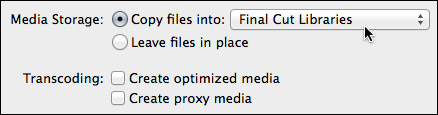
With Final Cut, you now have the ability to copy media into any selected library, or simply point (“link”) to where that media is stored on your hard disk. If you are very organized, linking is faster. If you don’t want to worry about where your media is stored, copy the media into the Library and be done with it.
Media can be copied without optimizing, if you want to edit using the camera native video format.
Libraries make working with media MUCH easier. But they work best when you copy the media into the library. Linking media, as with past versions of Final Cut, requires that you not move, or rename, any of the media files or the folders that contain it.
HOW IT WORKS
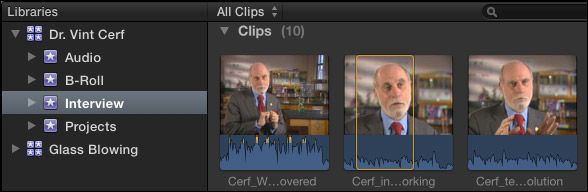
Here’s the new Library pane in Final Cut Pro X 10.1. (The Library pane is on the left, the Browser is on the right.) There are two open libraries: “Dr. Vint Cerf” and “Glass Blowing.” You can have as many libraries open as you want.
Inside the Dr. Cerf library are four events: Audio, B-roll, Interview, and Projects. Events act as folders within a library and can be named anything. There is no limit to the number of events stored inside a library. I store all my projects in a separate event, just to make them easier to find. You can store projects in any event. Media from any event can be used in any project.
NOTE: In earlier versions of Final Cut Pro X, there was an internal limit of around 2,000 clips per event. That limit was essentially removed in this update.
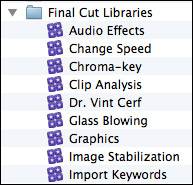
The library file is stored on your hard disk. Because most of my libraries are small, I store them on a RAID in a folder called “Final Cut Libraries.” You can store libraries anywhere and call them anything. Libraries do not need to be stored in folders. However, I always recommend storing all libraries and media files on a second drive (not the boot drive) for performance reasons.
The library file is actually a bundle, similar to the way Keynote stores its files.
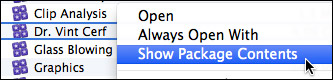
If you right-click on the Library name in the Finder, and select Show Package Contents…
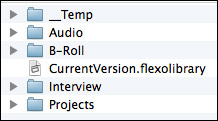
Inside is a folder for each event, which stores the actual media, as well as projects and other Final Cut work files. My STRONG recommendation is to stay out of this folder and don’t move the elements inside it. However, I wanted to let you know how this storage system works in case you ever need to rescue a clip from a library or an event.
NOTE: When copying or moving libraries, ALWAYS!!! move the entire library folder. Never mess with the database files or other individual work files in this folder.
UPDATING EVENTS AND PROJECTS
The new version of Final Cut requires updating all events and projects before they can be used. If you are someone that prefers to learn by watching a video, watch this eight-minute tutorial covering what you need to know to update existing events and projects.
Otherwise, read on.
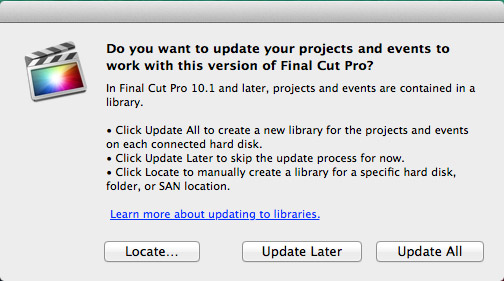
When you first start Final Cut, this warning will appear. Click Update Later. This allows you to open the program and take a look around without altering any of your existing events or projects.
Here’s what you need to know about updating:
If you have media stored across multiple hard disks, do the update first, then use File > Consolidate Events/Projects to combine all the media into one location. Consolidation is NOT required, but if it helps you to stay organized then go ahead.
To automatically update, select Update All.
To manually update:
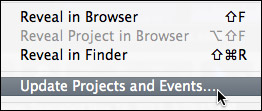
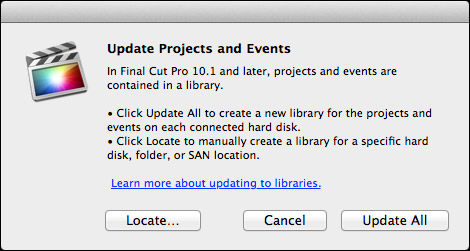
Next, click Update All. Only those events and projects you moved into the Events and Projects folders will be updated.
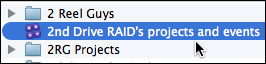
My hard disk is named “2nd Drive RAID.” The library that was created by the update is named “2nd Drive RAID’s projects and events.” You can rename this library to something more meaningful once the updating is complete.
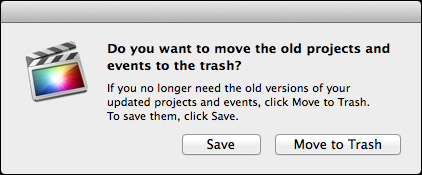
When the update finishes, you have the option to save events and projects or trash them. My recommendation is to save them until you know that the update process was successful. At which point, they can be deleted.
NOTE: If you select “Move to Trash” and realize you made a mistake, all is not lost. Simply open the Trash and drag the folders back out.
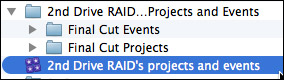
Notice that a new folder was created on 2nd Drive RAID and named “2nd Drive RAID…Projects and Events.”
The events and projects folders and their contents are not changed in any way. The information they contain was simply copied and converted into Final Cut’s new Library media management system.
GET MORE INFORMATION
Apple has provided additional resources in two white papers:
I’ve also written more articles to help you figure this out:
Also, the folks at Intelligent Assistance have released a free version of Event Manager X, along with a white paper, which can simplify the process of moving and updating older events and projects.
Website: www.intelligentassistance.com.
I just completed all-new training on Final Cut Pro X 10.1. To see the first 15 movies – which will give you a Quick Start into the application – visit my YouTube channel.
To download your own copy of my Final Cut Pro X training, please visit our store.
SUMMARY
Updating isn’t difficult, but you need to understand how the process works. To be safe, if you have the hard disk space, I recommend creating a backup of all events and projects before updating… just in case.
Then, update one event and one project and watch what happens. This is what I did as I was learning the system. Once you understand how this works, updating is simple. And, as I mentioned above, media is moved but not altered by this process.
The key is to decide how you want events and projects organized before you start the update process. And remember that you are not updating specific events or projects, but all the events or projects stored in the Final Cut Events and Final Cut Projects folders on a single hard disk.
The good news is that once the updating is complete, you never have to do it again. And libraries are a LOT easier to work with than the old Events and Projects!

2,000 Video Training Titles
Edit smarter with Larry Jordan. Available in our store.
Access over 2,000 on-demand video editing courses. Become a member of our Video Training Library today!
Subscribe to Larry's FREE weekly newsletter and
save 10%
on your first purchase.

125 Responses to Media Management is Biggest Change in Final Cut Pro X 10.1
← Older Comments Newer Comments →-
 Mark Ward says:
December 21, 2013 at 1:24 pm
-
 Larry Jordan says:
December 21, 2013 at 1:27 pm
-
 Larry Jordan says:
December 21, 2013 at 3:02 pm
-
 Tom says:
December 21, 2013 at 5:14 pm
-
 George says:
December 22, 2013 at 4:32 am
-
 Damian says:
December 22, 2013 at 10:00 am
-
 Mike says:
December 22, 2013 at 12:37 pm
-
 Larry Jordan says:
December 22, 2013 at 1:24 pm
-
 Dan Thomas says:
December 22, 2013 at 1:55 pm
-
 Mike says:
December 22, 2013 at 2:00 pm
← Older Comments Newer Comments →I, too, failed to read larryjordan.biz before upgrading to 10.1, and I, too, have lived to rue that day.
I had a project in which there were two WAV files with the same name—STE-000.wav. When I upgraded, one of them disappeared. There is a shortcut to it in my Final Cut Events folder (called “STE-000 (fcp1).wav”), but the shortcut is broken.
I recovered multiple WAV files from the formatted SD card on which it was originally recorded (with a Zoom H2), but that one file was not successfully recovered. I searched all the WAV files on my iMac—nothing.
Does that file still exist? Why would a Final Cut delete it and not just rename it?
Here’s a screenshot of the folder as it stands now: http://cl.ly/image/1z3N3c2f152J
mlwj
Tom & Noah:
Its probably a few weeks until the 3rd party community fully tests their applications. Let’s see what becomes available after the first of the year.
Larry
Mark:
All may not be lost. At the end of the update process, FCP asks if you want to save or trash the files.
If you clicked save, you’ll find all your source files, I hope, in a folder named after the hard disk that they were stored on.
If you clicked Trash, you’ll find them all sitting in the trash – provided you didn’t empty the trash.
Larry
Okay, after reading the “white paper” from Apple I feel a little better. FCP stores its own backups in my Movies folder (or wherever I want) which can easily be continuously backed up by Time Machine. That’s good – and that there’s an autosave vault, we didn’t have that before.
Now if I want to share with another editor, that’s a little unclear. Apparently if I want to make small library files for transfer, I have to set it for externally located media files. Which I haven’t done so far, so if I changed my mind at this point – how would I fix that? Not sure.
Hey Larry,
All the information is really helpful, thank you – unfortunately I only read it after I updated everything and then open Final Cut and had a mild moment of panic wondering where everything had disappeared to! No I have found it, but am having some issues.
I NEED YOUR HELP!! PLEASE!
I have a few external hard drives I work with and sometimes (due to space) use ‘events’ footage from one hard drive on a ‘project’ on a different hard drive. As I said I have found the new ‘Libraries’ created by Final Cut for each hard drive and now loaded/opened them all in FCX… but, any ‘projects’ that used to used ‘events’ from other hard drives have the rather distressing message of the red screen with a warning “!” and the words ‘missing file’…
The media is still there as far as I can tell on that other hard drive, but how please do I get it back into the ‘project(s)’ without having to copy it all over into the new ‘library’ and use up space I don’t have the luxury of…
What do I do!?
Hope that makes sense…
G
Hi Larry,
Thank you for the information! I have a question, Can I copy a project (without any media) and email it ?
I work with another editor long distance and we have the same media files and add to each others work emailing back and forth the project file.
Thank you and Happy Holidays!
I’m having the hardest time trying to figure out how to Close a project once I’ve opened it in 10.1. I realize the (to me) useful Project view of 10.0.9 is forever gone, but FCPX annoyingly “remembers” the last project I’ve opened each time I launch the app (and consequently the last Library opened). Ideally, I’d rather it open with an empty timeline rather than the last project I worked on.
Even if I close a Library and reopen it, there’s that darned open project again. In the past, at least I could “close” a project by clicking to go back to the project library.
Is there any way to close a project within an library once opened, or will I forever have to deal with the “messiness” of FCPX leaving my projects open?
(I suspect I know the answer, but thought I’d ask the question of those far smarter than I)
Appreciate any insight!
Mike
Mike:
Media management questions are the number one issue at the moment. So, I’m spending today writing an article on libraries and projects for tomorrow’s newsletter. I’ll have more answers for you then.
Larry
This isn’t the best solution, but it works. Create an empty library (mine is called “Untitled”), and leave it open. Close your “real” library and shut down FCPX. When you open FCPX again, it will open Untitled, which has nothing in it, so the timeline is empty.
I hope that makes sense.
Dan
Many thanks, looking forward to it!