
 [Updated Aug. 16, 2020, with additions and links in the closing section on “What Should You Do Now.”]
Last Monday, Apple announced that the Mac will be making a 2-year transition from Intel CPUs to systems based on new Apple silicon starting later this year.
Like any other Apple rumor or pre-announcement, we are still short many of the details of what these new systems will look like. And, truthfully, until Apple ships the hardware, we don’t really have any new decisions to make. Still, there’s lots to think about.
Apple’s announcements were focused on encouraging developers to update their hardware and software to support the new system. And, as you might expect, most will and some will not. That’s true of every transition to something new.
As end-users, our challenge is to be patient while Apple and the development community bring these revised products to market. Still, given what we know now, I am very, very excited about these new systems. Let me tell you why.
NOTE: Before I start, though, let me STRESS that you should not install beta software – like macOS Big Sur – on any system that you rely on for productivity. Beta software breaks. In fact, once Big Sur ships, you should still avoid updating until a .1 release is available. Just to be safe. Big Sur will be a big update – don’t rush into it.
BACKGROUND
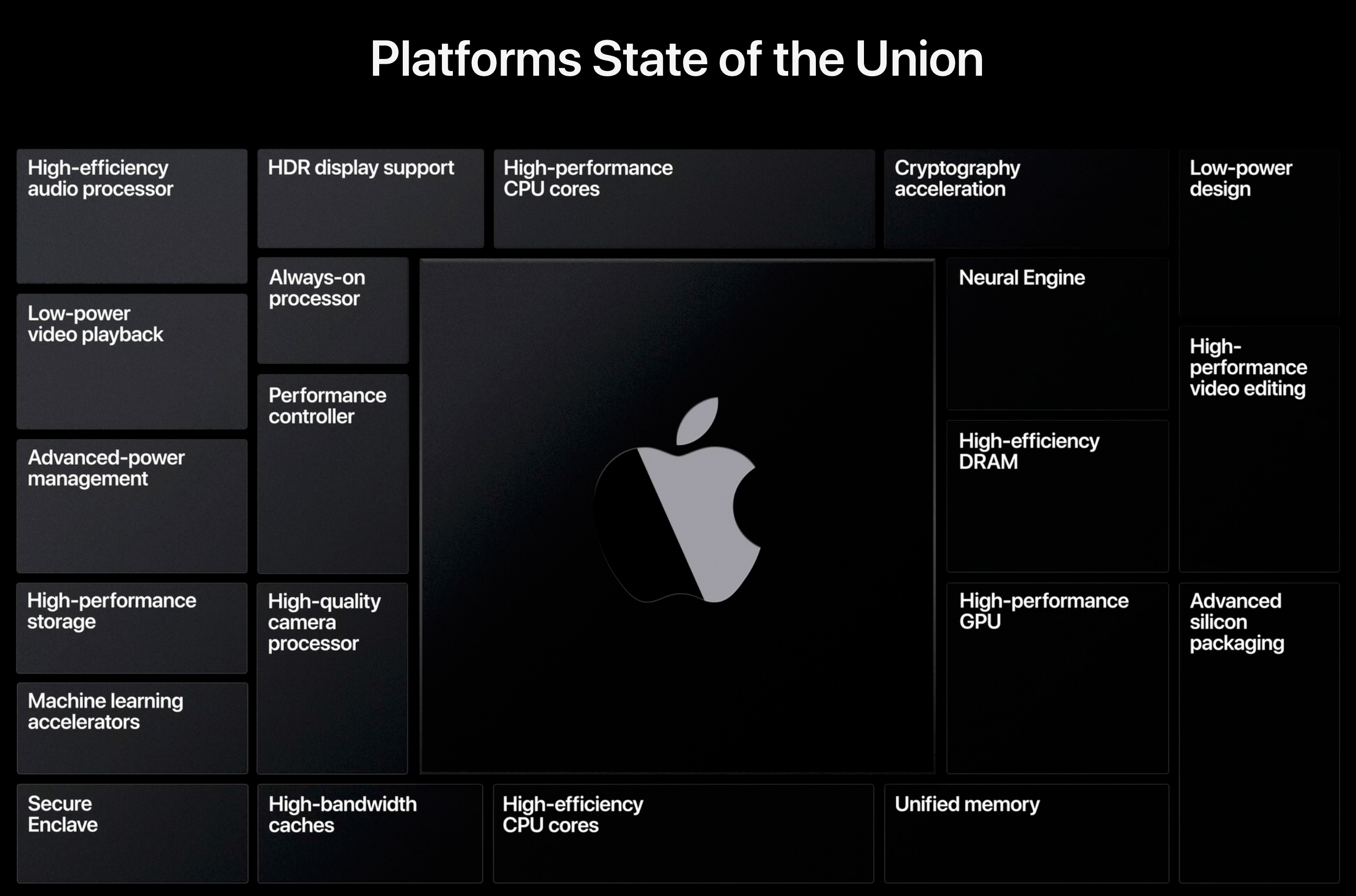
(Click to see larger image. Block diagram of an Apple silicon chip. Image courtesy of Apple, Inc.)
Rumors of Apple developing new ARM processors for the Mac first surfaced in 2014. These new chips were, I suspect, the reason behind Apple’s move to all 64-bit applications in Catalina, as well as discontinuing support for 32-bit codecs at the same time.
A friend, who develops chips for a living once told me that creating a new CPU-grade chip from scratch takes 3-5 years. So Apple started planning this transition a long time ago.
This is why Apple had so much of the conversion foundation nailed down when they announced the change:
This level of support is not built quickly, nor without carefully thinking through what developers need to convert their programs.
NOTE: It is important to note that the A12Z chip in the Development Transition Kit is not the most current Apple CPU chip. The current iPhone 11 uses an A13. The upcoming iPhone will use something even newer. This is why I’m not worrying about performance specs for these development systems. They are nowhere near the Mac-optimized CPU that will ship with the first Apple silicon Macs.
WHAT TO EXPECT
Apple has been designing, building and improving custom silicon for over a decade, starting with the iPhone and expanding into the iPad. This kind of work is neither easy nor cheap, however the success and performance specs of Apple’s mobile devices proves that Apple has the skills to create world-class chips.
“Building upon this architecture, Apple is designing a family of SoCs for the Mac. This will give the Mac industry-leading performance per watt and higher performance GPUs — enabling app developers to write even more powerful pro apps and high-end games. And access to technologies such as the Neural Engine will make the Mac an amazing platform for developers to use machine learning. This will also create a common architecture across all Apple products, making it far easier for developers to write and optimize software for the entire Apple ecosystem.” (Apple press release)
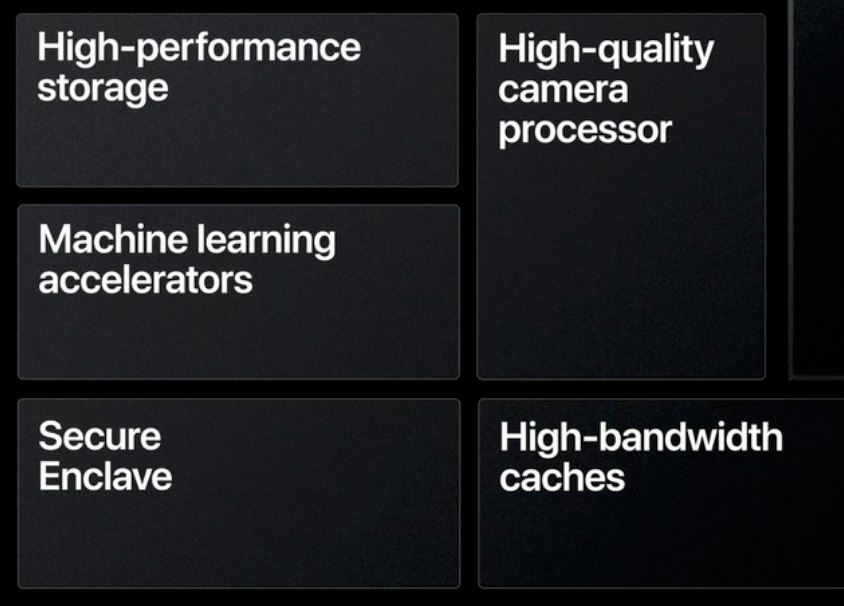
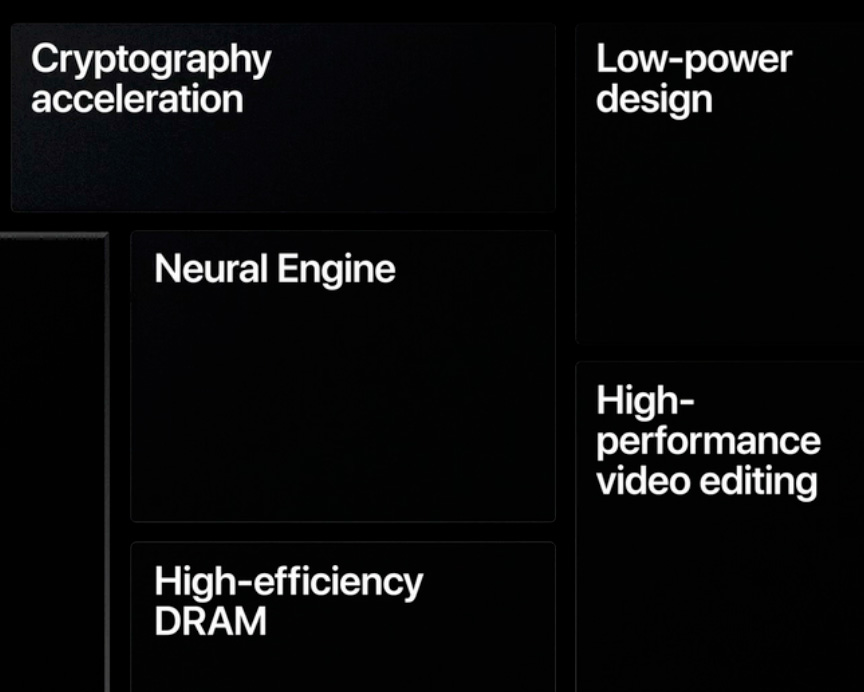
Apple silicon is more than just a CPU, it is a fully-integrated system – CPUs, GPUs, and a ton of supporting systems – all located on one chip. The block diagram above illustrates all the different components in this integrated system; Apple silicon is far more than just a CPU.
As you know from your own personal projects, buying something ready-made is fast and inexpensive, but rarely a perfect fit.
Creating something specifically for you – whether it is a custom shirt or custom database – means that you get exactly what you need. It takes longer and costs more, but, ultimately, makes you more productive because it works the way you need it to work.
Apple silicon is the exact same thing. It takes longer to create and costs Apple more, but, in the end, we get computer systems where all the pieces are carefully designed to fit together to maximize performance.
WHAT’S TO COME
There’s still a lot we don’t know. The Developer Transition Kits are not Macs. They are iPad chips in a Mac housing. They are specifically designed so that developers can test their code before actual Macs ship. Even so, the reports I’m reading show these chips are already roughly equal to some Mac desktops.
I have no doubt the final shipping systems will be far superior.
The challenge, in this transition, isn’t creating new software, but in updating the old. Several apps couldn’t make the transition from 32-bit to 64-bit. I’m sure there will be other older software that can’t be converted, either because the development team that created it is no longer working on it, or because the developers don’t feel there’s enough of a market for it.
What I find reassuring is that some of the most important legacy apps – Word, Excel, Photoshop – have already been converted and seem, according to Apple, to be working great in beta.
THINGS I LIKE
I am totally in agreement with Apple’s focus on privacy and security, as well as performance.
It is not in Goodle’s self-interest to enforce privacy. Microsoft is late to the privacy party and under EU scrutiny over privacy in Office 365. Apple’s focus on this is critically important. Just as an example, the latest reports this week of apps that surreptitiously copy clipboard data from iPhones – or even nearby Macs – bring the need for system-level privacy and security forcefully to mind. There is no reason apps like TikTok, CBS News, or the New York Times need access to our clipboards.
As well, Intel security flaws like Meltdown, Spectre or the unfixable CPU flaw of 2019, all point to the continued need to focus on security and privacy in hardware as well.
I also like multi-threaded CPUs, as well as multiple GPUs on the same chip. While less helpful in video compression, both these features will significantly benefit both audio and video editing.
WHAT SHOULD YOU DO NOW?
For now, all we can do is wait. However, don’t get too worried – yet – about reports that the new system “will never be able to do [X].” A lot of this is click-bait reporting or political posturing. No one knows – outside of Apple – what these new chips can do. And, given Apple’s track record, they tend to under-promise and over-deliver.
NOTE: Remember, Big Sur runs on both Intel and Apple CPUs. You won’t need to worry about Apple silicon compatibility until new hardware is released and you decide to buy it.
The Mac is a vibrant market for creative applications – developers have no reason to abandon it. For now, I fully expect media software from Adobe, Blackmagic Design and Apple to support the new system at the same time as, or closely thereafter, to the launch of new hardware. Avid will support it eventually, but they have a lot of legacy code to convert first.
This new system architecture will show up first in laptops, a few months later in iMacs, then, finally, the Mac Pro. Systems that need more CPU power will take longer to develop. While laptop upgrades are rumored for the end of 2020 to early 2021, new CPUS for iMacs or the Mac Pro have not even appeared on rumor sites.
If you need new hardware now, buy it. Intel systems are proven, solid, high-performance and will last for years. If you don’t need new hardware, you are better off waiting until the new systems with Apple silicon in them ship. Then you can make an informed decision on which CPU architecture is best for your work.
NOTE: An interesting observation that several engineering sites make is that Apple silicon runs Windows better in emulation than many Windows systems run it natively. Here’s a report, from the Electronic Engineering Journal, that goes into this in more detail.
In all cases, we don’t have anything to decide today. Apple silicon is not shipping. However, truthfully, I’m already saving my pennies for the new hardware. The Macs I currently own have stood the test of time. I fully expect the new systems to do the same thing – and take us places we’ve never gone before.
Brave new worlds, indeed.

2,000 Video Training Titles
Edit smarter with Larry Jordan. Available in our store.
Access over 2,000 on-demand video editing courses. Become a member of our Video Training Library today!
Subscribe to Larry's FREE weekly newsletter and
save 10%
on your first purchase.

18 Responses to Thoughts on New Macs with Apple Silicon [u]
← Older Comments-
 Patrick says:
June 29, 2020 at 3:54 pm
-
 Larry says:
June 29, 2020 at 4:50 pm
-
 Larry says:
June 30, 2020 at 1:50 pm
-
 David Morgan says:
July 1, 2020 at 10:10 pm
-
 Larry says:
July 2, 2020 at 8:07 am
-
 Shameer Mulji says:
July 2, 2020 at 11:26 pm
-
 Nick Syrett says:
July 6, 2020 at 9:01 am
-
 Larry says:
July 6, 2020 at 9:12 am
← Older CommentsIf the system works for you today, it is not a bad investment.
Patrick:
I agree. Any modern computer will last for years and perform as well then as it does now. If the gear you have today delivers the projects you need on spec and on-time, then there’s no reason to worry about replacing it until something SERIOUSLY better arrives to take its place.
I talk with editors daily who are still producing quality work with Mac Pros that are ten years old. New hardware is fun and exciting to talk about. But the reason we buy the hardware is to get our work done. Nothing has changed that in any way slows down or prevents our current gear from working as well as it ever has.
Larry
Clayton:
All good points. Since Apple Silicon was well into development when the Mac Pro was announced, I would find it very strange that Apple would not have plans for a processor upgrade for it. Especially because so much else of the system can be upgraded.
And, like you, I’m saving my pennies to purchase a new Apple Silicon iMac. I look forward to what this new technology will allow us to do.
Larry
yes but how long will it be before Apple releases a new OS that won’t run on Intel processors? Seeing the way Apple operates, it will be sooner than later. Forces people to keep buying the hardware
David:
Here I disagree. Apple still releases macOS versions that run nVIDIA GPUs, which Apple hasn’t shipped since 2013. I know, because I own a computer that I use every day with nVIDIA GPUs.
There’s no reason for Apple to discontinue Intel support quickly – it would cut off all their existing base. I take them at their word that they will support Intel for many years.
Larry
Given your long history with Apple and using its products, which Mac do you predict will be the first model with Apple Silicon?
Larry and Patrick,
Good points. Thanks for responding. You are right, my new MacPro performs fantastically and will do for many many years to come.
Shameer:
Smile…. I’ve long ago given up when Apple will do something or what it will be. Apple will get these systems to market as fast as it can. Everything is complicated by COVID-19.
Still, Apple tends to under-promise and over-deliver. I expect systems sooner, rather than later. But not immediately – developers still need time to test and tweak their software.
Larry