
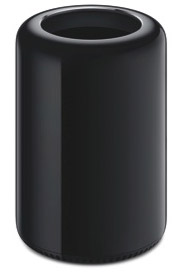
 First, let’s be clear: The new MacPro is not yet shipping. So, like a group of blind folks describing an elephant, we are getting a lot of different opinions on what this new animal is.
Second, the instant Apple revealed it at the WWDC last spring, I wanted one.
Third, buying new hardware is stressful and expensive; especially when it comes to hardware essential to our business.
So, the question I want to answer today is: Since I need to save my pennies to buy this, where do I get the best bang for the buck? And my answers are the same if I were working with Final Cut Pro X, Adobe Premiere CC, or audio editing in ProTools or Audition.
If money means nothing to you, then buy the system with all the bells and whistles. Then, sit back and smirk while the rest of us hate you. For most of us, buying hardware is a trade-off between what we want and what we can afford. In other words, if finding the balance between the best performance at the best price is important to you, this article is for you.
BACKGROUND
Last week, Apple posted more details about the MacPro (including performance and tech specs): http://www.apple.com/mac-pro/
They also announced two configurations: a four-core CPU system starting at $2,999 and a six-core CPU system starting at $3,999. Within those two categories, Apple has not yet announced any other options or pricing. The MacPro is scheduled to ship in December. No date was announced.
Based on what we know, there are five areas we can spend money on with this unit:
So, given these choices, where should we spend our money?
WHERE’S THE BEST BANG FOR THE BUCK?
 Surprisingly, it isn’t the CPU. Any CPU today can easily edit video – even high-resolution video. If you are editing single stream video, even high-resolution, the four-core system will be more than adequate. More cores will be helpful with multicam editing.
Because rendering and exporting is off-loaded to the GPU, a screamingly-fast CPU is not as important as it was in years past. Again, more cores and faster CPU speed is nice, but no longer essential. There are better places to put your money.
Specifically, the best place to spend your money is on the GPU. Get the fastest one you can afford, with as much VRAM as possible. Whether you are editing with Premiere Pro CC or Final Cut Pro X, both max out GPU performance.
RAM is user-upgradeable. This means that you can buy less than you might ultimately need, then upgrade as RAM prices come down and third-party vendors provide reliable upgrades. For me, I’d start with a minimum of 8 GB, then add RAM via third-parties.
NOTE: I don’t expect a lot of RAM options to be available at launch. It will probably take suppliers like Kingston – www.kingston.com – or Crucial – www.crucial.com – a while to ramp up to meet demand.
SECOND NOTE: I spoke with the folks at Kingston earlier today, who told me that, according to the specs of the MacPro: “It can take [RAM] up to 1866MHz in speed, and up to 16GB modules in each of the four slots. We will have memory for this. [Since] the product will be released in December we don’t have an ETA on our memory yet.”
STORAGE
The Mac Pro supports up to 1 TB of SSD (Solid State Drive) storage. First, you don’t need that much, and second, I’m not convinced SSDs are the way to go for media. Instead, an SSD drive is ideally suited for the boot drive. I have an SSD-enhanced iMac (a Fusion drive) that goes from powered off to fully operational in nine seconds. I expect the MacPro to be even faster.
SSD drives are ideal for files that are accessed over and over. This means that you get the best performance when accessing operating system and application files. This also means that you don’t need to get the biggest SSD; the OS and applications you get will never fill it.
Let me give you a specific example. On my current MacPro, my Application folder contains the entire Adobe CS6 and CC Suites, plus the entire Final Cut Studio (3) Suite, FCP X, and every plug-in and software gewgaw known to the mind of man. And the total Application folder takes only 42 GB to store.
In fact, everything on my boot drive – EVERYTHING – is only 220 GB. (And that includes a desktop folder that holds more files than I will ever admit to storing in public.) A boot drive of 250 GB is more than adequate for the OS and applications.
NOTE: There’s an axiom in the storage business that the faster a unit transfers data, the less data it can hold and the more it costs.
Rather than buy a large, internal SSD drive, I plan to spend a small fortune on a high-speed, fully-loaded Thunderbolt RAID 5 with a minimum of 8 drives. THAT provides all the storage and performance I need — even for editing 2K multicam clips containing up to 30 angles!
Think about it. Shoots are creating more and more media. My recent 13-episode 2 Reel Guys shoot geneerated 1.5 TB of data. There is no reason this should be stored on a boot drive. External media is plenty fast, holds a ton of media and can be easily transported from one place to another.
Spend your money on external storage, not the internal SSD drive.
A NOTE ON SPEED
Simply connecting a single hard drive to a computer via Thunderbolt does NOT mean you are getting Thunderbolt speeds. Just the opposite. As a rough measure, a spinning hard disk that is not enhanced with a small internal SSD booster, can read and write data about 120 MB/second, whether it is connected by USB 3 or Thunderbolt. (FireWire, by contrast, slows the drive down to about 80 MB/second.)
This means that in order to get the speed you expect from a Thunderbolt connection, you need to keep combining drives in a single unit (which is what a RAID is). To fully saturate (fill) a Thunderbolt 2 pipe, you would need a RAID containing about 20 drives!
A THOUGHT ON SLOTS
There’s been a lot of complaining about the lack of PCIe slots on the MacPro. I’m sympathetic, but, frankly, I’m not bothered by this.
Every significant vendor who supplies hardware to the Mac community is working on Thunderbolt devices. AJA, ATTO, Blackmagic Design, Matrox, Sonnet — all of them. Why? Because Thunderbolt devices are easier to install, configure, and, most importantly, support.
Plus, the new hardware data bus inside the Mac Pro is faster than the PCIe bus we’ve been using in current MacPros.
NOTE: For those with significant investments in PCIe cards, Sonnet has announced an expansion chassis that holds the cards and converts the interface into Thunderbolt 2.
For me, the simplicity of plugging in what I need and getting on with my work FAR outweighs the slight performance increase that might be obtained by custom-building a system. (Then, again, I’ve never been fascinated by doing my own home or car repairs. Others, though, find it fascinating. Each to his own.) I prefer getting work done to wasting time configuring; and Thunderbolt 2 is so blazingly fast, that I don’t expect to ever fully utilize it; even for high-resolution media.
SUMMARY
I plan to buy a new Mac Pro the week they ship, though probably not the first day. (As I’ve written before, I prefer to let someone else intercept the first arrows.)
I’ll spend more money on the GPU than the CPU. And I’m already looking for storage for this system. As we get closer, I’ll let you know what I decide to buy and how I configured it.
As always, I’m interested in your opinions.
Larry

2,000 Video Training Titles
Edit smarter with Larry Jordan. Available in our store.
Access over 2,000 on-demand video editing courses. Become a member of our Video Training Library today!
Subscribe to Larry's FREE weekly newsletter and
save 10%
on your first purchase.

96 Responses to Larry’s Thoughts on the New MacPro
← Older Comments Newer Comments →-
 Leo says:
November 14, 2013 at 10:35 am
-
 Tim Kolb says:
November 14, 2013 at 10:40 am
-
 Don B says:
November 14, 2013 at 10:45 am
-
 Leo says:
November 14, 2013 at 11:06 am
-
 Tim Kolb says:
November 14, 2013 at 11:35 am
-
 Bill says:
November 14, 2013 at 11:36 am
-
 Bill says:
November 14, 2013 at 12:07 pm
-
 DaleJohnson says:
November 20, 2013 at 2:40 pm
-
 Larry Jordan says:
November 20, 2013 at 2:52 pm
-
 Dick Walters says:
November 20, 2013 at 3:44 pm
← Older Comments Newer Comments →Larry, I agree that optical discs are going to go away at some point, but I don’t as yet see a delivery format that works when you make your money selling individual discs. Most projects I get paid for the project, but some, I get paid by how many DVDs I sell of a given event. I guess there may be a point when things like recitals and graduations won’t be recorded? Or, maybe a fee will be charged which covers the cost of production and they can “tune in” on YouTube or Vimeo etc and see what they paid for? I just don’t know how that will work out since many live events have music played you can’t control and it will get flagged by YouTube etc software detection.
Oh well, that solution sounds fine for now. They don’t need any updates really since DVD/BR hasn’t changed much for years. lol
I’m not sure at what point Apple invented the work station…while “Johnny come lately” BOXX Systems isn’t Apple, they aren’t trying to be… But make no mistake, the new Mac Pro will be measured against the fire-breathing, exceptionally stable (and exceptionally well-supported) BOXX workstations that are used for heavy lifting in post production along with HP’s Z8xx monsters.
The new MacPro, and its ecosystem of peripherals will need to compete with the expansion potential of these Windows machines, many of which have replaced MacPros which have become out dated over the time the product line has been stagnating…
Macs are great, but unless FCPX is your specific tool of choice, they have to compete for seats in the world of video post production on the basis of cost-effectiveness. That will only be known once the machines are shipping.
Leo, Encore runs on Mac — it’s part of the Adobe suite. If you don’t want to subscribe you can still get CS6 online, but may not be worth it if this is the only program you’ll use. Encore is great. The Adobe Production suite is great, too.
“Workstation” “MacPro” call it what you will. It’s a computer! BOXX makes their money on what? Selling software or boxes? Mac makes their money on what? Selling software, boxes, tablets, phones, apps, music, video…. So they seemed to have decided that their next machine needs to compete or I guess they’ll fold up that tent. Why else would they bother making a new machine?
We all know they have not updated the Pro line in a while which is why this is much anticipated. It will either make or break them for about 5 years in this part of their business if they can’t deliver a decent, or GREAT product. So I agree, they do need to compete, but BOXX is not the only company making computer workstations to do video editing on and I doubt it runs FCPX which may actually be the way of editors of the future. Remember, it’s what most kids and teens and young filmmakers are using and will get used to now. So, like it or not, it may be here to stay despite what some of us older folks think about the way it “looks” or “feels”.
What’s actually nice about this new machine is that many who have adopted iMac as their machine of choice with Thunderbolt peripherals is that they won’t need a whole bunch of new cards to add or internal drives to fit into it. They just plug the thunderbolt add-ons and keep moving, only much faster (we all presume).
I guess FCPX making the MacPro an obvious choice was my point…I’m significantly less of an FCPX detractor than most non-FCPX users are…the software is being adopted and used and it will have its place, no question.
My second point though was that the machine will have to compete for seats for users of cross-platform software, and the large Windows boxes have made significant inroads in that market over the last handful of years.
I admit that I hoped cost of entry would have been cheaper, but a large part of that is the cost to Apple of the components. Intel charges a lot for their high end chips. If I were to upgrade my 2008 8-core to a 6-core 2013 mac pro, it will probably be at least $5000, with the extra peripherals, and give me 80-100% speed improvement. I could still use my raid card with an external chassis, but all that adds up. So the speed improvement really needs to be impressive to justify the upgrade since I can still update to an SSD, already got a 7970 card (which by the way, seems to run slower than the 5770 in fcpx, which I’m hoping will change come fcp x 10.1). So my machine runs around 10,000 on geek bench, the new 12-core is somewhere around 30,000, but is probably going to cost over $7000…so I guess a few tweaks on my current mac pro will probably suffice. I just hope intel won’t take 4 years to update to the next xeon. But then if they don’t have any competition from AMD, then we’re stuck on Intel’s whims.
Oh, I do think fcpx really does need an ssd, I have a 7200 WD Black as my boot drive and all sorts of user interface lags occur that honestly drive me nuts at times. Plus, when I paste effects to clips, you have to often re-click on the clip to get it to appear…its like the caching of the software reverts to the last clip you were looking at…strange and annoying at times. So hopefully those interface bugs will be addressed as well.
I saw an article on an app that can remove a siren from a location recorded track, as well as do other amazing clean up chores. I thought I might have read that article on your web site, but have been unable to find it. Is this something you might be familiar with?
Thanks
Dale:
Yup.
Sony Creative Software “Spectral Layers” or Izotope’s RX3.
Larry
My workflow and my bank account will probably dictate that I keep my 2010 MacPro and perhaps upgrade the GPU to a flashed ATI 6870.