
 Recently, I got an email from a reader asking how to change Project Properties in Final Cut Pro X. It isn’t hard, but there are a couple of hidden steps.
Most of the time, when you create a project, the settings are fine; especially when you let your Project auto-configure itself based upon the first clip you edit into it.
However, every so often, you edit the wrong type clip in first and the Project configures incorrectly, or you want to change the image size, or the render format. Here’s how.
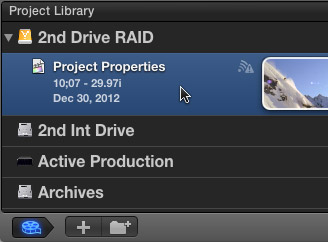
Select the Project you want to change in the Project Library.
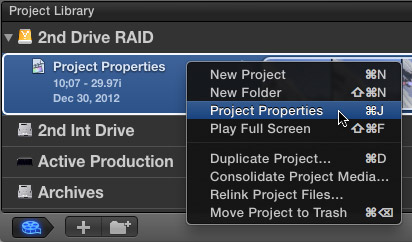
Then, either right-click the name of the project, type Command+J, or choose File > Project Properties.
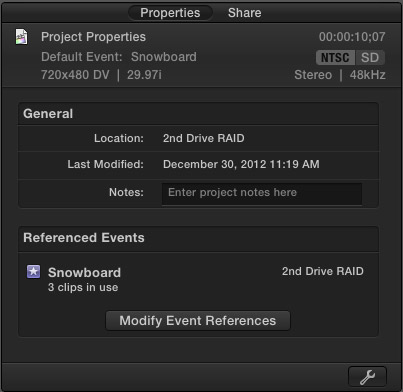
This opens the Properties tab in the Inspector.
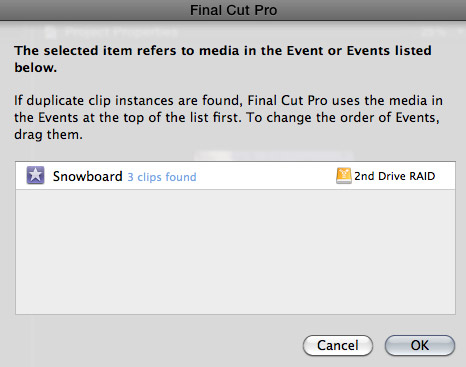
Clicking the Modify Event References button allows you view which Events are storing the media used in your Project. If you are using multiple Events, you can change their priority by dragging them up or down.
NOTE: Personally, I’ve never used this feature. However, it is nice to know it is here.
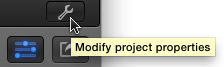
Click the Wrench icon in the lower right corner to open the Project Properties panel.
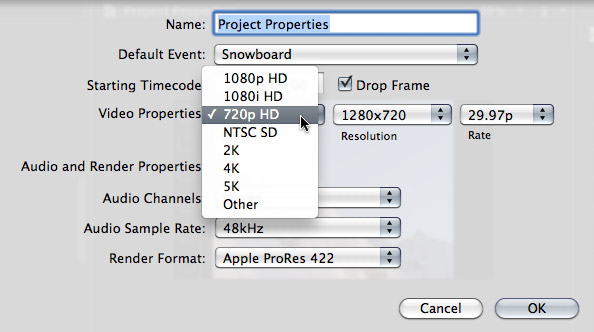
Here, you can change many of the settings of your project; including starting timecode and image size. However, once you have media edited into your Project, you are not able to change frame rate.
If you need to change the frame rate, the easiest thing to do is create a new Project, then copy the clips from the old Project and paste them into the new one.
NOTE: The best time to change project properties is when there are no clips edited into the sequence. When a sequence is empty, any property can be changed.
When you are happy with your revised settings, click OK.
Done.

2,000 Video Training Titles
Edit smarter with Larry Jordan. Available in our store.
Access over 2,000 on-demand video editing courses. Become a member of our Video Training Library today!
Subscribe to Larry's FREE weekly newsletter and
save 10%
on your first purchase.

51 Responses to FCP X: Change Project Settings
← Older Comments Newer Comments →-
 LarryJ says:
July 20, 2014 at 10:36 am
-
 Suzi P says:
February 15, 2016 at 8:58 am
-
 Larry says:
February 15, 2016 at 10:10 am
-
 Suzi Piker says:
February 15, 2016 at 5:25 pm
-
 Larry says:
February 15, 2016 at 6:29 pm
-
 Suzi Piker says:
February 16, 2016 at 8:32 am
-
 angelo Bosco says:
November 14, 2016 at 10:12 am
-
 Manan fredriksson says:
March 22, 2017 at 2:16 am
-
 Kathy says:
May 18, 2018 at 8:12 am
-
 Larry says:
May 18, 2018 at 8:19 am
← Older Comments Newer Comments →Personally, I prefer pixels – however, others may prefer Percentages. I don’t have a recommendation.
And, by scaling I am referring to the setting in the Transform section of the Inspector.
Larry
Hi Larry,
I know this is an old thread but I’m hoping for your wisdom. I have a project that is comprised of 720 59fps (interviews and broll) and some 1080i (30fps broll).
My goal is to setup, edit and export this large project as best as possible from the onset.
I have two questions:
1) regarding size: should I edit on on a 720 and convert the 1080 down?
2) regarding frame rate: Knowing that my interview tape is 60fps … Can I still achieve optimal playback when it coverts on my timeline to 24 fps? Should I use another frame?
rate?
Everything was optimized when I was imported.
Best,
Suzi
Suzi:
The KEY!! thing is to edit your project based upon the format you need to deliver. If you are delivering 1080, edit 1080. If you are delivering 720, edit 720. Also, avoid changing the frame rate unless you have to. Match everything to your final deliverable format. If you are going to the web, there is NO!! benefit to changing the frame rate.
Larry
Larry,
Oh how I want the key 🙂 My final delivery format is flexible in the sense that I want the best possible product to be available via Vimeo. What settings might yield the best results knowing that I have to choose a size AND rate and then pull this unmatched footage in? Will my key interviews shot at 59.94 suffer at 24fps? What are the downsides of going with 720? Thanks so many times in advance.
Suzi:
Vimeo is VERY flexible and strongly prefers progressive instead of interlaced video.
Given what you’ve shot, I’d recommend editing 720p 59.94 and scale the 1080 footage into it. You’ll get the best quality for Vimeo that way.
larry
Thanks, Larry — Since I have some 29.97 footage — is there a downside of converting the 59.94 to 29.97?
Thanks so much for this- really helped
Hey Larry
I’ve just edited a project in 1080p which is now going to be shown in a cinema. They’ve requested the file be 2k/DCP which it obviously wasn’t shot in. Is there any work around?
Many thanks
Manan
I’ve usually shot interlaced but am noticing that when it’s compressed to 264 (unfortunate necessity) the lines are very apparent. I can shoot progressive on my Sony. Which is the better of the two to use? The pieces are for the web at the moment but client may ultimately want them on television. Thanks.
Kathy:
Always, always, ALWAYS!! shoot progressive. Always. It is easy to go from progressive to interlaced. It is life-altering to go from interlaced to progressive; worse, the images look terrible.
Larry