
 [IMPORTANT NOTE: With the release of the 10.1 update to Final Cut Pro X, I released all new training that covers both new and old features. I encourage you to buy this, or become a subscriber, because it will help you learn the new software quickly. Click here to learn more.]
Since the release of Final Cut Pro X 10.1 a couple of days ago, my email has exploded with questions – and, it probably won’t surprise anyone to learn that media management is number one on the list. So here are the answers to common questions, along with some “secret tips” that make working with libraries easier. This is the first of four articles on media management. The others are:
NOTE: Here is a very important article on updating media, events, and projects from earlier versions of Final Cut Pro X. Please read this before you update.
Apple has also provided additional resources in two white papers:
And here is a video webinar that illustrates these, and more, media management techniques for Final Cut Pro X.
DEFINITIONS
A Library is a container that holds media, events, and projects. You can have an unlimited number of libraries open at once and you can open and close libraries as needed. Final Cut requires a minimum of one library to be open at all times.
NOTE: Even though computers are using faster SSD and Fusion drives, I still recommend that libraries and media be stored on a fast second drive or RAID. In my case, I store all my libraries on an attached Thunderbolt RAID.
Events are folders that are contained inside libraries. A library must contain at least one event. There is no limit to the number of events that can be contained in one library. The easiest way to to think of an event is that it is a folder, or bin, that stores stuff.
NOTE: In earlier versions of Final Cut Pro X, there was a limit of about 2,000 clips that could be stored in an event. That limit was, essentially, removed.
Projects are the instructions on how to edit our clips; they are now analogous to sequences in Final Cut Pro 7. (Here’s an article that explains how to manage projects.)
Media is stored in libraries, or referenced by libraries, and can be moved or copied between projects, events, or libraries.
WORKING WITH LIBRARIES
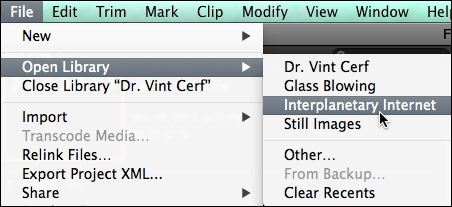
To open a library, select File > Open Library and select from the recent library list.
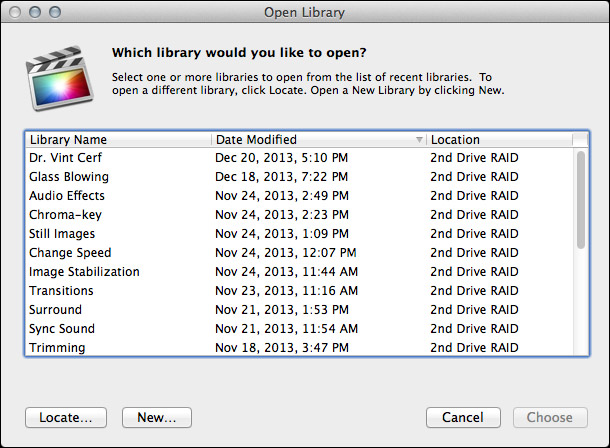
To open a library that isn’t on the list, select File > Open Library > Other. This displays a list of all the libraries that Final Cut knows about.
To open a library that you know exists, but Final Cut does not display in its list of libraries, click the Locate button in the bottom left corner. Select the library you want to open from the File Picker window that appears.
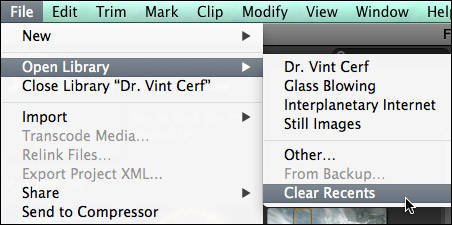
To clear the list of recently opened libraries, select File > Open Library > Clear Recents. This list repopulates based on the libraries that you either reopen or create.
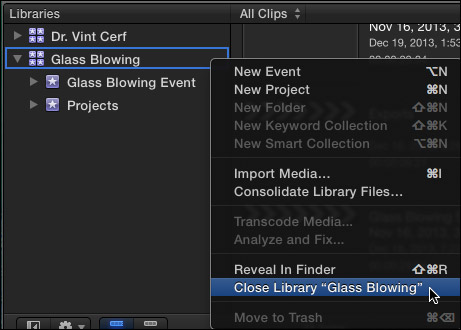
To close a library, select the library you want to close, then do one of the following:
SECRET LIBRARY TIPS
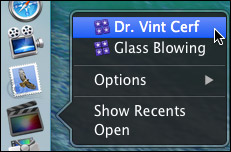
To open Final Cut with a specific library selected, right-click the Final Cut icon in the dock and select the library you want selected after FCP opens.
NOTE: All other open libraries will also open when you use this tip.
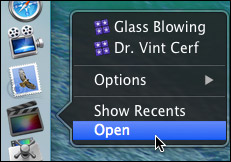
To open Final Cut with ONLY one library open, regardless of how many libraries were open when you last quit Final Cut, press and hold the Option key as FCP opens. Then, select the library you want to open from the list.
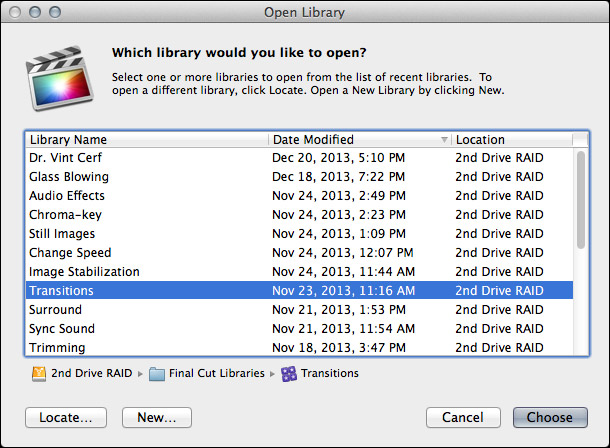
NOTE: You can not close the last remaining open library inside Final Cut. To close a library that you no longer want, open a different library, so that there is always one open library in FCP.
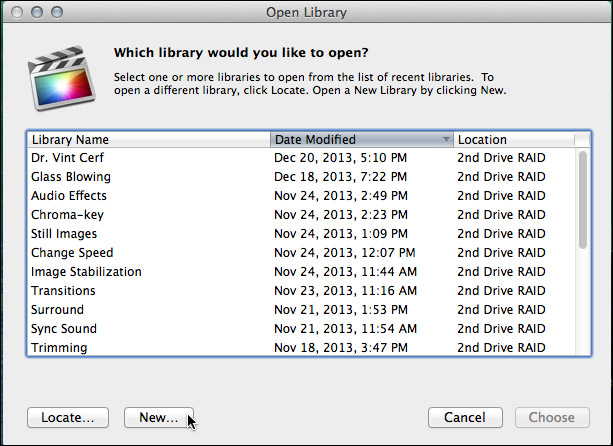
Final Cut Pro X always requires at least one library, containing at least one event to be open. To open FCP with an empty library and event (and all other libraries closed), press and hold the Option key when starting FCP from the dock and click the New button in the bottom left corner.
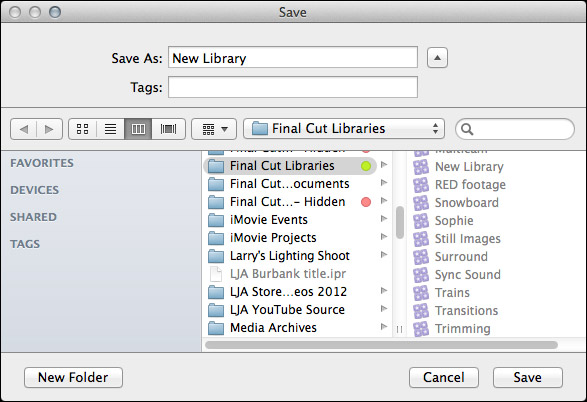
Remember, libraries can be named anything and stored anywhere.
NOTE: Because libraries contain media and render files, be sure to store these to a high-speed storage device. And, I continue to recommend not storing media to the boot drive.
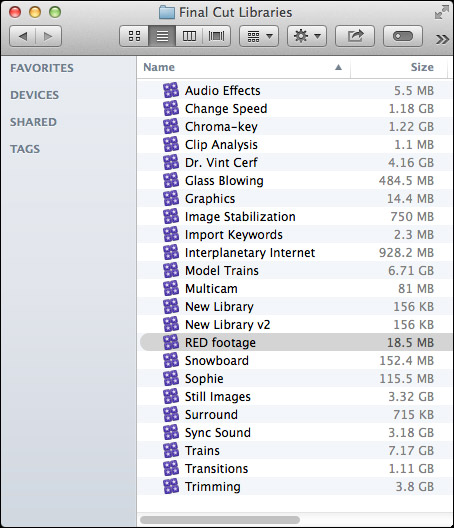
To open a specific library, double-click the library icon in the Finder.
LIBRARY BACKUP
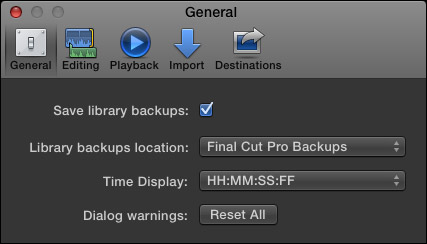
To backup a Library database, go to Final Cut Pro > Preferences > General and make sure Library backups is turned on. This defaults to storing backups in your Home directory. You can specify another location from the pop-up menu.
NOTE: This backup also includes backups for every project and event database contained in that library. It does not backup media. This makes archiving library data easy, because you don’t need to backup the media contained in the library, just the database.
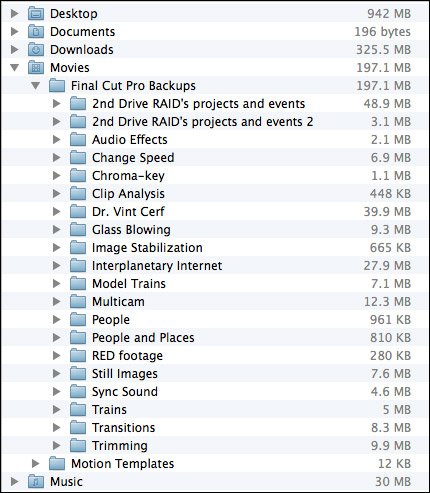
By default, library backups are stored in: [Home directory] > Movies > Final Cut Pro Backups. As you can see, the library database is not that big. (On the other hand, these are not large projects.) Backups are made every 15 minutes.
RESTORING LIBRARIES FROM BACKUPS
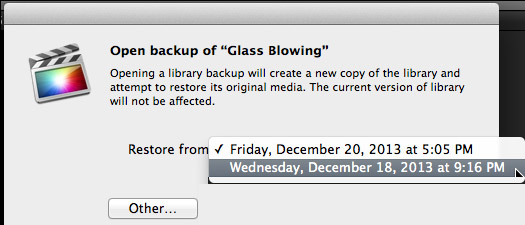
In the Libraries list, select the library you want to restore and choose File > Open Library > From Backup.
In the “Restore from” popup menu, select the backup date and time you want to restore from. Or, click Other, to select a different backup file. This backup file is added as a library in the Libraries list.
NOTE: The backups are standard Final Cut Pro library files, so you can also open them by double-clicking them in the Finder.
LIBRARIES ARE BUNDLES
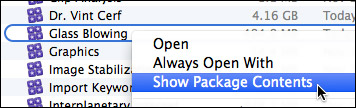
Libraries act like a file, but they are actually a bundle. Right-click a library name in the Finder and select Show Package Contents.
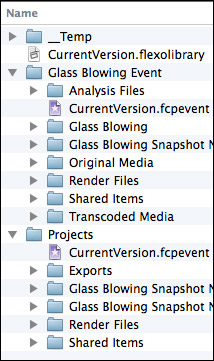
Inside, you will find folders containing all events, projects, snapshots, media, and related files. (This is the new incarnation of the old Final Cut Events and Final Cut Projects folders.)
I STRONGLY recommend you not mess with the files inside this folder for any project you care about. However, if you are looking for ways to access media or project files, this is the place to look.
DELETING A LIBRARY
Libraries can not be deleted from within Final Cut. Apple made this decision to prevent the accidental erasure of all our work. To delete a library, select it in the Finder and delete it like any other file.

2,000 Video Training Titles
Edit smarter with Larry Jordan. Available in our store.
Access over 2,000 on-demand video editing courses. Become a member of our Video Training Library today!
Subscribe to Larry's FREE weekly newsletter and
save 10%
on your first purchase.

154 Responses to FCP X 10.1: Manage Libraries
← Older Comments Newer Comments →-
 Larry Jordan says:
February 18, 2014 at 12:30 pm
-
 Modeste says:
February 18, 2014 at 3:31 pm
-
 Giuseppe says:
February 18, 2014 at 4:49 pm
-
 Larry Jordan says:
February 18, 2014 at 5:17 pm
-
 Modeste says:
February 28, 2014 at 12:12 am
-
 Larry Jordan says:
February 28, 2014 at 1:42 pm
-
 Megan says:
March 11, 2014 at 5:21 pm
-
 Larry Jordan says:
March 11, 2014 at 5:42 pm
-
 Megan says:
March 11, 2014 at 8:08 pm
-
 Daniel says:
March 11, 2014 at 9:59 pm
← Older Comments Newer Comments →Modeste:
Since Libraries can be stored anywhere, Apple no longer displays the hard disk in the Library list.
Larry
Thanks Larry.
Larry
Could you give me a quick run through of how to store events and/or libraries on an external drive, rather than on the computer itself? (I’ve just updated to the new FCPX and I’m still having some trouble finding my way round).
Thank you!
Giuseppe:
When you create a new library, FCP asks you where you want to store it and what to call it. At that point, select the hard drive you want to use.
Libraries do not need to be installed in any particular folder – put them whereever you want.
Larry
Hello Larry, I need some videotutorials for Final Cut X Pro, Motion and After Effect. I saw the price on your website. Now, how and where to view them. Thanks in advance for your reply.
Modeste.
Modeste:
You can purchase these in my store.
FCP X: http://www.larryjordan.biz/app_bin/Store/catalog/product_info.php?products_id=343
Motion 5: http://www.larryjordan.biz/app_bin/Store/catalog/product_info.php?cPath=64_85&products_id=272
(I don’t have training on After Effects.)
Thanks,
Larry
Hi Larry,
I just finished a fairly involved project. At the beginning of this project when I imported all my files, I selected the check box “copy files to Library.” Now, having finished the project, my library is over 576 GB. Is there any way to downsize the library or relink the files so that this project doesn’t take up over half the space on my external drive?
I don’t know if this is helpful information to know regarding my question, but if I look at the Library folder in Finder, I can see that there is one folder called ‘Original Media’ which is 140.92 GB and another folder called ‘High Quality Media’ that is 409.06.
And so I know for future reference, is there any actual benefit to checking the “copy files to Library” box?
Thanks,
Megan
Megan:
Here’s an article that explains when to use Copy files and when to Leave Files in Place:
http://www.larryjordan.biz/fcp-x-10-1-collaboration/
If you KNOW!! that the project is done, you can delete the HIgh Quality Media folder, inside the Library. However, replacing this later, while possible, is a major pain in the neck, so don’t do this if there’s a chance you or the client will want changes.
Larry
Thanks. I think the client may want a couple of changes, so I will leave it as is for now.
Hi Larry, I found this page because I’m working with Final Cut Pro X, and I had a similar issue to the poster above.
I used to use Final Cut Pro X and was pretty good at it, then I deleted it to use Adobe Premiere, however that didn’t work as well on my computer, so I redownloaded Final Cut X. However, now I’m trying to import files off of my hard drive, but Final Cut seems determined to see my hard drive as a camera, so I can’t look through any of my folders I’ve organized. It sees all of the files (all 30,000 of them) on my hard drive, but it doesn’t see the folders they’re organized in, so I can’t find any of the files I need to import. It has no difficulty seeing the folders from my desktop, but it can’t see anything from my hard drive. I don’t have all of the cards that have been on my hard drive (some of them were from years ago) so I don’t know what to do. Do you have any idea how I can have Final Cut recognize my hard drive as a hard drive and search through the folders in it?
Thanks!