
 I’ve written about how to move:
* An FCP 7 project to Premiere Pro
* An FCP 7 project to FCP X
* An FCP X project to Audition
* An FCP X Project to Premiere Pro CC
So, in this article, I want to show you how to move a Premiere Pro CC project to Final Cut Pro X.
We do this in three steps:
However, there are some cautions in this process: Not everything transfers perfectly. I’ll talk more about this at the end.
INSIDE PREMIERE
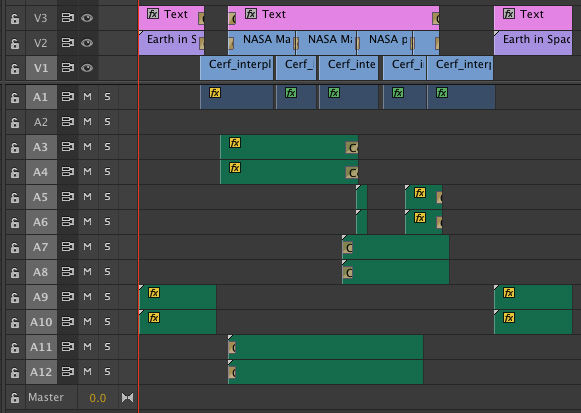
Here’s a typical project inside Premiere. There are several things to note here:
Notice that all stereo audio starts on an odd-numbered track. This is important. Most software assumes that stereo pair audio will be on two separate tracks and further assumes that the left channel starts on an odd track. I have found that I get the most reliable transfers when working with multi-track stereo audio when the left channel is placed on an odd-numbered track. (Premiere does not care if there are gaps between audio clips, nor if an entire audio track is left blank.)
NOTE: This project is based on an older Premiere project, where stereo audio spanned two tracks. In the current version of Premiere, stereo audio can appear as a single clip in a single track. When moving projects between Premiere and FCP X, whether stereo audio is on one or two tracks does not make a difference; as long as when audio spans multiple tracks, the left channel is placed on an odd-track.
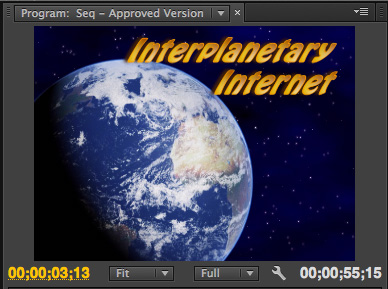
Thinking about text, notice the text color and formatting in this opening title…
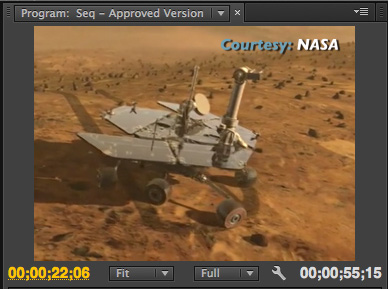
…and the formatting of this locator text.
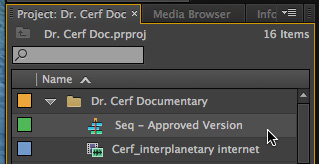
To transfer a project from Premiere, select the project in the Project panel. Then, choose File > Export > Final Cut Pro XML.
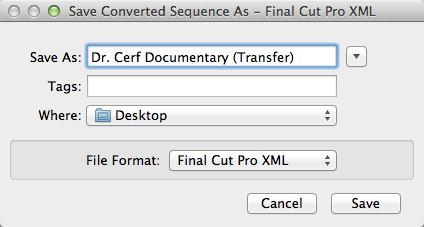
Give the XML file a name and storage location. Here, I’m calling it “Dr. Cerf Documentary (Transfer)” and storing it to the Desktop.
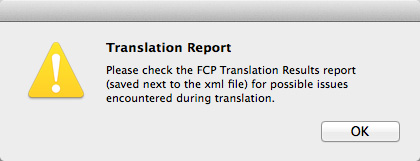
A warning message appears, indicating if Premiere had any problems with the transfer.
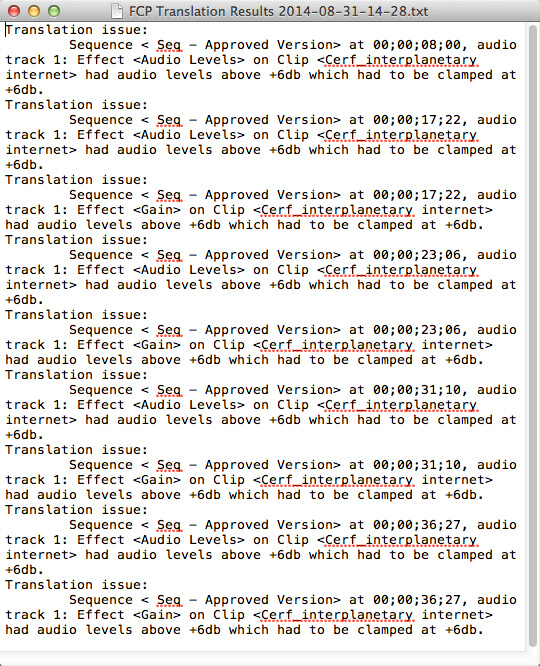
In this case, all problems relate to audio levels. (This is the Translation Results report from this export. Different projects will generate different reports.)
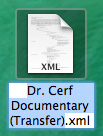
After a few seconds, the XML file appears on the Desktop.
NOTE: XML files are very small – generally, just a few hundred KB. They are only needed to transfer information from one program to another. Once the data has been transferred, the XML file can be deleted. For this reason, I tend to store them to the Desktop to make them easy to find and delete when this process is complete.
CONVERTING FOR FINAL CUT PRO X

FCP X and Premiere use different versions of XML, so we need to convert the XML file so that Final Cut can read it. This requires a utility from Intelligent Assistance called: “7toX” — it’s available in the Mac App Store for $9.99. Here’s the link.
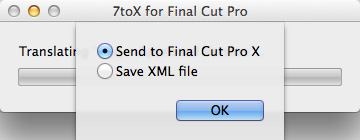
Either start the application and select the XML file, or, much easier, simply drag the XML file on top of the application icon. This dialog asks what you want to do with the converted XML file.
While sending the file to FCP X is the fastest, when it comes to transferring files, I tend to be a “belt-and-suspenders” kind of guy. I prefer to do this in two steps:
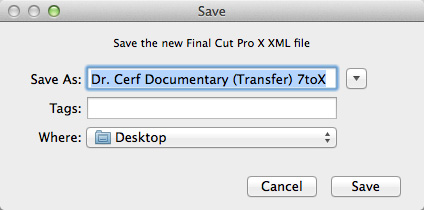
So, I chose the “Save XML File” option, gave it a name and storage location and clicked Save. The translation process starts and only takes a few seconds.
IMPORT INTO FINAL CUT PRO X
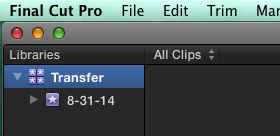
Start Final Cut and create a new Library.
NOTE: Creating a new Library is optional, as you’ll see in a minute, but I prefer to transfer projects to their own library.
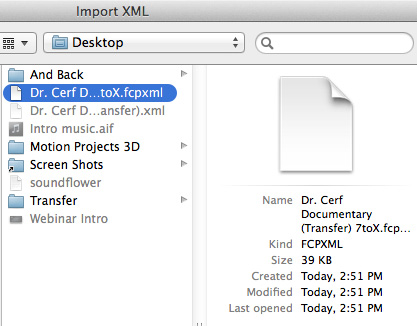
Choose File > Import > XML. Select the converted XML file and click Import.
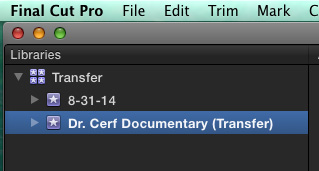
The transferred project is imported as its own event, with the sequence and media inside. (This is why creating a new library is optional.)
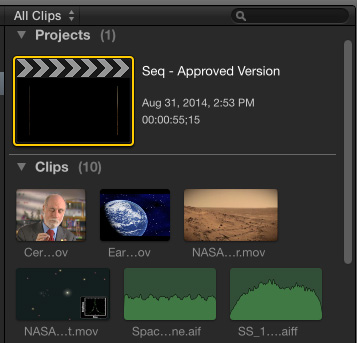
As you would expect, the project and all media are displayed in the Browser.
THINGS CHANGE
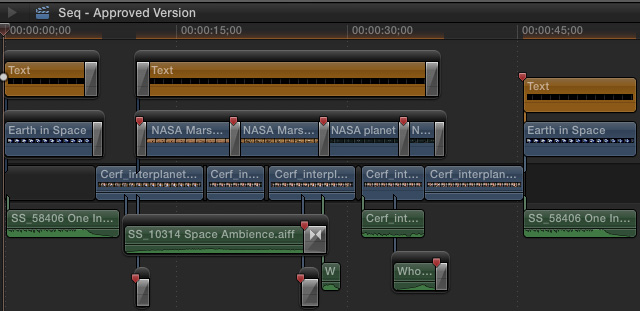
Here’s what the transferred project looks like, inside FCP X.
NOTE: In discussing this article with the folks at Intelligent Assistance I was told they have encountered issues where Premiere can play media that isn’t recognized by FCP X because it wasn’t ingested and rewrapped as MOV. This just points up that it is important to transfer files ahead of your deadline so you have time to fix problems if they occur.
SUMMARY
If I were doing this for real, rather than writing an article about the process, transferring files is very fast. Assuming all software is installed, moving large projects from Premiere to FCP X would generally take a couple of minutes, at the most.
In today’s interconnected world, moving edits from one application to another is fast and easy. The trick is knowing what transfers and what doesn’t. Media and edits are ALWAYS safely transferred. The issues all relate to effects.
EXTRA CREDIT
As we’ve just seen, because of the differences between Premiere and Final Cut Pro X, not everything transfers successfully. We have similar problems when sending files between different versions of Final Cut, Avid and Premiere.
While all edits and most media transfer successfully between applications, most wipes, effects and color grading do not. This is because each application handles these differently which means that the best time to transfer files is when the edit is complete but effects are not yet started. Here’s a white paper from Intelligent Assistance providing more details on what transfers and what doesn’t.
Also, the following suggestions on media are taken from the 7toX help files:
Carefully consider the media format of your video clips. For example, Final Cut Pro X can support R3D clips directly, whereas Final Cut Pro 7 needs RED QuickTime Wrapper versions of the clips. Black video usually means that your NLE is missing a plug-in. If you’ve installed a Final Cut Pro X plug-in to support your camera’s format, then you’ll need to download and install a version for Final Cut Pro 7 or Premiere Pro. (Import a clip directly into Final Cut Pro 7 or Premiere Pro to see if the camera format is supported.) The most reliable way to get media that works in Final Cut Pro 7, Premiere Pro and Final Cut Pro X is to transcode to your favorite flavor of ProRes.

2,000 Video Training Titles
Edit smarter with Larry Jordan. Available in our store.
Access over 2,000 on-demand video editing courses. Become a member of our Video Training Library today!
Subscribe to Larry's FREE weekly newsletter and
save 10%
on your first purchase.

47 Responses to Premiere Pro CC: Transfer Projects to Final Cut Pro X
← Older Comments-
 Larry says:
September 14, 2021 at 12:51 pm
-
 Joseph Taravella says:
November 11, 2021 at 1:19 pm
-
 Larry says:
November 11, 2021 at 1:29 pm
-
 Joe Taravella says:
November 11, 2021 at 4:05 pm
-
 Larry says:
November 11, 2021 at 6:38 pm
-
 Joe Taravella says:
November 16, 2021 at 9:52 am
-
 Larry Jordan says:
November 16, 2021 at 10:21 am
← Older CommentsModayf:
I need a bit more information before I can help. What isn’t working: importing, creating, formatting, exporting or displaying captions…?
Larry
Hi Larry! I am having this weird issue where only one Canon camera’s footage in the premiere timeline is showing up completely blank in fcpx.
There aren’t even any individual blank clips in the fcpx project as placeholders, just one long continuous blank slug where all of the camera’s footage was used in premiere pro. Yet none of the other 2 Sony cameras footage have this issue.
All 3 cameras files were the same (.mp4). Any ideas? Thanks for your time!
Joseph:
If the Canon footage is black and the Sony footage is good, this sounds like an incompatible codec issue to me.
If you can see the video in Final Cut, that means you can also see it in Compressor. Use Compressor (or Final Cut, if you don’t own Compressor) to convert it to ProRes 422. At which point, Premiere will be able to easily edit it.
Larry
I’m sorry I wasn’t clear that I’m actually trying to bring an xml file from premiere and bring it into Final Cut Pro x. In premiere I exported xml for Fcpx and then used “send to x” to convert it. When it’s opened in fcpx is when I can’t see the canon footage, but I can see it fine in premiere. Should I try to convert the canon footage to prores, the. relink to the prores files in premiere, and then try to export the xml out of premiere?
Joe:
If the clips and edits come into FCP as expected, but the video is black, that tells me that that the XML file is fine, but the codec is not compatible with FCP.
In which case, yes, create a ProRes version of the clip in Premiere / Media Encoder and substitute that in your Prmiere Project. Then, when you import the XML file, the Canon footage should import and display with no problems.
As a tip, create a small test project in Premiere to test this idea, before committing to your current project. If it works for the small test, it will work for your project in general.
Larry
Just to follow up on this… The incompatible original camera files were indeed what the issue was. I converted the clips to prores, imported those into adobe premiere, exported the xml sequence out of premiere to fcpx, used “send to x” and then imported into fcpx and they showed up just fine.
I even did a test sequence where I placed the original camera files right behind the converted prores clips on the same sequence, and when I imported the xml sequence from premiere into fcpx the original camera files were nowhere to be found. No slug, no missing file error, just a blank space where those clips existed in Premiere. THANK YOU SO MUCH FOR YOUR HELP!!!!
Joe:
Thanks for the update. I’m glad converting the files solved the problem.
Larry